Showing posts with label Biography. Show all posts

Tuesday, October 19, 2010

The Immortal Life of Henrietta Lacks by Rebecca Skloot


The Immortal Life of Henrietta LacksSkloot, Rebecca. The Immortal Life of Henrietta Lacks. New York: Crown Publishers, 2010.

My Summary and Review

The Immortal Life of Henrietta Lacks was written powerfully. In 1951, Henrietta Lacks, a young mother, died from a vicious form of cervical cancer. Prior to her death, a doctor removed some cancer cells without her permission, and had the cells grown in a lab culture. Over several years, her cells (named HeLa cells) were used in countless experiments, benefitting the field of medicine and medical industries. For many years, her family never knew of her cells' importance, and faced many struggles, including poverty.

Rebecca Skloot covers the HeLa cells' story quite clearly. Readers who aren't medical specialists can understand her descriptions. More importantly, Skloot gives a human face to the development of the field of field of bioethics in the 20th century.

Who has the final say over the medical testing of humans and human tissues: patients or doctors? And should patients know all the risks regarding the tests in which they are participating?

One subject addressed in this book is particularly horrifying: researchers in the 1950s did not seek patient consent or disclose all pertinent information before involving patients in medical tests/trials. New information has been published that is relevant to the medical history provided in The Immortal Life of Henrietta Lacks. In 2009, information was discovered about a 1940s study in which 696 Guatemalan prison inmates were intentionally exposed to syphilis by American researchers.

Amidst this bleak historical period, Skloot draws an overwhelming portrait of the struggle of a human family to survive and to understand the seemingly impossible information about the use of their mother's tissues to further scientific knowledge.

Further Information

Rebecca Skloot interview with Steve Paikin on Canadian Broadcasting Corporation's "The Agenda". http://www.youtube.com/watch?v=tnUp0xQlfK8&feature=fvst


Canadian Broadcasting Corporation. U.S. sorry for Guatemala syphilis experiment. Updated October 1, 2010. http://www.cbc.ca/health/story/2010/10/01/syphilis-guatemala.html
 

Wednesday, August 25, 2010

Stand Straight, Ella Kate : The True Story of An American Giant by Kate Klise and M. Sarah Klise


My Summary
When you think of a giant, what comes to mind? Jack and his beanstalk? Fables? Fairy tales?

Ella Ewing (1872-1913) was a real American giant! By the age of thirteen, she was almost six feet tall. At seventeen, she was 8 feet tall. Being bigger wasn't always better, though, as many people were mean to Ella.

Take a walk in Ella's large shoes, and learn how she used her height to become famous, to travel, and to accomplish what many "normal" people from her time could not dream of.

My review
Through the illustrations, readers get a good sense of Ella's size, especially on the title page, where her head bends at the top beside a lamp shade so that her body can fit on the page. Also quite interesting are Ella's size-related facts on the inner cover pages of the book. Imagine having size 24 feet! An excellent beginner biography.

Sunday, May 9, 2010

A Funny Thing Happened On the Way to the Future By Michael J. Fox

Book Information

Fox, Michael J. A Funny Thing Happened on the Way to the Future ... Twists and Turns and Lessons Learned. New York: Hyperion, 2010.

My review

Michael J. Fox's newest memoir is short, smart, funny, and targeted to youths and college graduates. In 100 pages, he sums up what he learned from the most challenging school: the School of Hard Knocks. He discusses the "economics" of being a starving young actor. He played with the laws of physics during "Back to the Future" and soon after his diagnosis with Parkinson's. And what better way to learn geography than through travel? Whatever the subject matter, Fox is a master on it through his lived experiences, where valuable mentors and personal interests have taken the place of trained teachers.

Michael J. Fox is also piercingly honest about his past drinking habits, and about his difficulty in accepting his Parkinson's diagnosis at a young age. He is equally clear in his message that adapting to new challenges can create positive opportunities.

My Notes

I enjoyed "Back to the Future" and another book that I recently reviewed: Always Looking Up. This book can be easily read in one or two sittings. I also particularly agree with his views on the importance of mentoring, since I have learned a lot of job and life skills through some important mentors in my life too.

Sunday, April 25, 2010

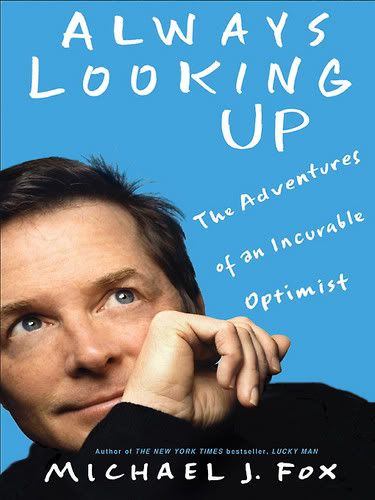
Always Looking Up: The Adventures of an Incurable Optimist

Fox, Michael J. (2009). Always looking up: the adventures of an incurable optimist.  New York: Hyperion.


My review


Get ready! Rev up your DeLorean for a short trip through time. Michael J. Fox's memoir of the last decade chronicles his transition from "Spin City" actor to passionate crusader in the fight against Parkinson's. His memoir is divided into four sections: "Work", "Politics", "Faith", and "Family".


The memoir opens with a strong and funny start, describing his average morning battle with Parkinson's. After founding the Michael J. Fox Foundation, Fox became a figure of political controversy for advocating for research on the potential of embryonic stem cells to cure Parkinson's.


His writing style is occasionally over-the-top (at one point, he jokingly refers to himself as "Mahatma J. Gandhi"). While the first two sections are strong, the areas on Faith and on Family can be interpreted as sentimental, and as focusing on trivial events. There is also no question that many people will take issue with his politics. This book is a worthwhile read for many reasons. It's written in a way that people can see a human face behind Parkinson's, and it sheds light on the politics behind research and change.


My notes
I picked up this book because I used to enjoy "Back to the Future." I still struggle with the ethical implications of embryonic stem cell research, but have high hopes for the future in science and research.

Tuesday, February 2, 2010

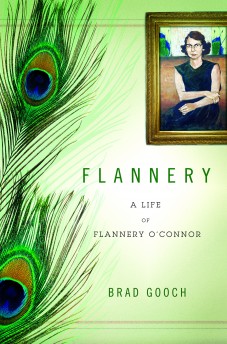
Flannery

My Review

Readers who enjoy Flannery O'Connor should take a look at Brad Gooch's Flannery. This book draws on a variety of sources, including interviews and letters, to provide a well-rounded portrait of the humor, religious devotion and social times that strongly influenced Flannery O'Connor and her work. Gooch brings to light many of O'Connor's personality quirks, including her fondness for birds and her solitary nature, and uncovers many of the real life people and incidents that appear in her stories and novels.

Gooch, Brad. Flannery: A Life of Flannery O'Connor.
Little, Brown and Company, 2009

464 pages


Personal Notes

I received this book as a Christmas gift, and was thrilled to read it. As a university student, I read and enjoyed Flannery O'Connor's A Good Man Is Hard to Find. Since I own a pet budgie, I was intrigued by her fascination with birds (and her ability to train a chicken to walk backwards!) What I really admire about this book is that Gooch does not overplay O`Connor`s struggles with lupus, and writes respectfully of her life and hard work.